Business Waste Removal in Penge
Business waste removal in Penge needs to be practical, tidy and easy to arrange, whether a workplace is clearing out packaging, mixed office rubbish or bulky items that no longer belong on site. We handle commercial waste with a focus on straightforward collections, sensible sorting and clear communication, so the work can be organised without disrupting the day. If you need a service that fits around trading hours and the realities of shared premises, this is the right place to start.
Our business waste removal service is built for day-to-day commercial clearances, one-off office tidy-ups and regular disposal of accumulated rubbish. We can remove a range of non-hazardous materials commonly produced by shops, offices, workshops and other premises, helping keep back rooms, storage areas and loading spaces usable. Where details matter, we look at what needs taking, how it is stored and what sort of access is available, so the collection plan is realistic from the outset.
For a wider view of related services, you can also look at general waste removal and our pricing and quotes page for the factors that commonly shape a quotation. If you already know the kind of clearance you need, give us the key details and ask for a quotation; if not, we can still help you narrow the job into manageable parts before anything is booked.
Commercial collections that suit working premises
Commercial rubbish is often less about one dramatic clearance and more about the steady build-up of items that take over useful space. Cardboard, broken fittings, redundant stock, archived paperwork, office furniture and general mixed waste can all create pressure in storage rooms and shared areas. We keep the service practical by identifying what can go together, what needs separate handling and what should be described clearly when planning the collection.
Different premises need different levels of organisation. A compact office may only need a simple single-load pickup, while a larger site may have several categories of waste stored in different parts of the building. We can work from a clear description of the load, or from a brief site plan if that is easier, and we always aim to keep the process direct. The point is not to overcomplicate it; the point is to remove the waste efficiently and responsibly.
If your priority is clearing space for staff movement, stock rotation or a refit, start with the main items that need going. You can list the largest pieces first and then note the smaller mixed waste around them. For a broader commercial tidy-up, our office clearance service is also useful when desks, chairs, filing units or other workplace items need to be removed together as part of one organised job.
What business waste can usually be removed

Every commercial site produces waste differently, so the collection has to match the load rather than forcing the load into a fixed template. Typical items may include office chairs, shelving, packaging, shredded paper, redundant displays, small fixtures, non-permanent fittings and some broken equipment. The exact mix matters because it affects handling, lifting and sorting, especially where larger or heavier objects are involved.
Some items need more care than others. Appliances, sharp materials, confidential documents and anything potentially classed as hazardous should be described clearly before collection, because those categories may need a different approach or separate arrangements. For example, confidential shredding is relevant where paperwork cannot simply be mixed in with ordinary waste, while fridge and appliance removal is a better fit for certain bulky units than a general mixed-load pickup.
A sensible brief helps keep the collection organised. Useful information usually includes whether items are upstairs or downstairs, whether they are loose or bagged, and whether any pieces need dismantling before removal. A short prepared note can be enough, so long as it is specific. Clarity beats guesswork, especially when the load contains a mixture of light and heavy items that need different handling.
Planning the collection around your premises
Business waste removal works best when the collection is planned around access, parking and the layout of the premises. That may mean checking whether items are in a front office, a rear yard, a basement, a mezzanine or a shared corridor, because the route out can shape how the job is approached. The more precisely the waste location is described, the easier it is to choose the right collection method and keep disruption low.
It also helps to think about the order in which items can be reached. A pile sitting in front of a fire exit, loading bay or storage shelf may need to be moved in stages, while loose rubbish spread across several rooms can be gathered before removal begins. We can work with a simple description, but a more detailed one often leads to a clearer quotation and a smoother pickup. If you are not yet sure what needs special handling, make a quick inventory before you ask for a price.
When a business is clearing several rooms at once, it can be worth separating the work into sensible groups. Useful groupings might include paperwork, furniture, packaging and miscellaneous waste, because each group can be assessed more easily. For larger premises, the same logic applies on a bigger scale: identify what is staying, what is going, and what is too awkward to leave until the day without prior mention.
Office, stockroom and back-of-house clearances

Some commercial collections are best understood as clearances rather than simple bin collections. An office may need desks, chairs, monitors and filing items taken away together; a stockroom may need old packaging, unsellable stock and broken shelving removed in one visit; a back-of-house area may have accumulated mixed waste that does not belong in day-to-day operations. These jobs are often about restoring order as much as removing rubbish.
Our approach stays focused on the practical tasks. We identify what needs lifting, how much can be moved safely and whether anything should be dismantled before it is taken out. Where the waste includes furniture, our furniture clearance and furniture disposal pages describe related options for items such as chairs, tables, shelving and other pieces that are no longer needed in the workspace. If the load includes a full set of office items, this can often be grouped into one well-structured collection.
In some premises, a clearance is part of a wider change such as relocating departments, reducing stored stock or preparing for new equipment. Those situations are easier to manage when the items are described in categories. A short list of what is present and what must remain can save time later, and it gives us a better basis for a quotation without turning the enquiry into a long exercise.
Types of waste and how they are handled
Not all business waste behaves in the same way, so handling decisions should be based on the material itself. Light packaging can usually be gathered quickly, while mixed or awkward items may need a different approach. Hard plastics, wood, metals and textiles may be sorted separately if that helps the load move more efficiently. The aim is to keep the collection workable and avoid unnecessary handling where the waste is already organised.
Where suitable, recyclable material can be separated from general rubbish so that the collection reflects what is actually in the load. That does not mean every item needs to be sorted in advance by the customer, but it does help if obvious categories are kept together where practical. Our recycling and sustainability page covers the kind of approach that can support responsible disposal, while the main service stays focused on taking the waste away in a sensible way.
For business customers, a good result is usually one that balances tidy removal with minimal disturbance. That can mean keeping walkways clear, protecting access routes and making sure larger items are moved in a way that suits the building. If there are fragile fittings, limited turning space or shared access points, say so early. Those details do not make the job impossible; they simply help shape it correctly.
About Penge
Penge is a district in the London Borough of Bromley, in south-east London, shaped by its position between neighbouring parts of Inner London and the green edge of Crystal Palace Park. The area grew significantly in the nineteenth century after the arrival of the railway, and traces of that suburban expansion still influence its streets today. Penge High Street remains the best-known local thoroughfare, running through an area where shops, residential streets and everyday services sit close together. The railway history is especially important to understanding Penge’s development: stations in and around the district helped turn what had been a more rural settlement into a connected London suburb with a recognisable local centre.
Bulky items, fittings and workplace furniture
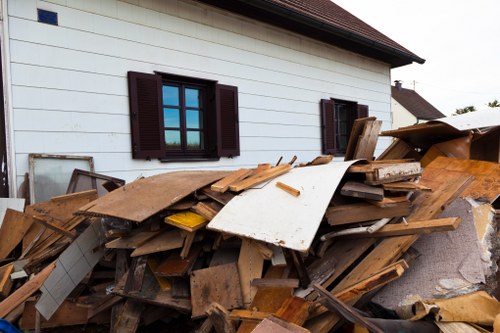
Many business clearances involve more than loose rubbish. Desks, cabinets, reception seating, shelving, counters and display units often need to be lifted out before the waste area can be properly cleared. These items can be awkward because of their size rather than their weight, so the job may depend on whether they can be dismantled, carried through narrow doorways or taken down stairs in sections. Careful preparation makes a difference here.
Where furniture is still serviceable, some businesses prefer to separate it from the rest of the load so the disposal route can be chosen appropriately. Where it is broken, water-damaged or beyond use, the emphasis shifts to safe removal and responsible handling. If mattress or sofa-type items are part of the clearance, our mattress and sofa disposal page may also be relevant, though the main commercial service remains the better match for mixed workplace waste and general office items.
If several large items are being removed, it is useful to identify any that have detachable parts, glass panels, loose shelves or sharp edges. That helps us plan the load more accurately and reduces delays on the day. In commercial settings, good preparation is often about simple details: which items are staying, which are going, and whether anything needs to be moved first so the rest can follow.
Understanding quotation factors for commercial waste
Quotation requests are usually clearer when they focus on the practical elements that change the amount of work involved. The type of waste, the quantity, the weight, the access route and any special handling all matter. A few small bags in an easy ground-floor location will naturally be a different job from a larger mixed clearance that includes furniture, packaging and items stored in a basement or upper floor.
That is why it helps to describe the load as accurately as possible. You do not need to write an essay, but you should mention the main categories, where the items are kept and whether anything needs dismantling. If a site contains some items that are straightforward and others that are more awkward, separate the two in your description. If you are ready to move ahead, ask for a quotation and include the basic facts in one clear message.
For businesses comparing options, it can also help to know whether the work is a one-off clearance or part of a repeated disposal pattern. A recurring load may be easier to plan if the same type of material appears regularly, while a single clearance may need more attention to access and grouping. Either way, the more specific the description, the more useful the response is likely to be.
Simple steps before you request a quotation

A few simple steps can make a commercial waste enquiry easier to handle. First, identify the main items that need taking away and decide which ones are definitely part of the load. Next, check where they are located and whether they can be reached without moving other equipment. Finally, note anything unusual such as locked access, narrow stairs, heavy file storage or items that might need separating before removal. That is usually enough to start a sensible quotation.
When you are dealing with mixed waste, it can help to separate the obvious categories before sending your enquiry. For example, keep paperwork distinct from furniture, and keep broken equipment separate from packaging where possible. If you want to compare the scope with a more general collection, our office clearance and waste removal pages provide related service descriptions that may help you decide how to phrase the job. Clear details lead to clearer planning, especially on busy commercial sites.
Ready to move on? Tell us what needs removing, where it is stored and when the site is available, then request your quotation. If the job includes specialist items or multiple categories of waste, mention them up front so the plan can be shaped properly. For straightforward commercial collections in Penge, that is often all that is needed to get started.